| |
|
 |
 |
|
|
|
|
|
|
David Brainerd: Aflame for God
by Eugene Myers Harrison |
 |
|
A frail young man, with sad, lustrous eyes and face so blanched that he seems to be the palest of the palefaces, is engaged on a serious and dangerous mission. Having heard of a tribe of particularly ferocious Indians living in the dense forests of the region known as the "Forks of the Delaware," he is on his way to tell them of a loving Saviour. Coming at sunset in sight of the smoke of their campfires, he decides to spend the night in the woods and to proceed in the morning. Little does he realize that several red men, with wolfish eyes and as silent as serpents, have followed him for hours. As he builds a fire, the Indians steal away to their encampment to tell the startling news that a white man is in the woods nearby. "Let us go at once," says the chief, "and kill this paleface, whose people have taught us to drink firewater and then, while we are drunk, have taken our baskets and skins and even our lands for almost nothing." |
|
As the warriors silently draw near, they see the white man on his knees, praying most fervently that the Indians might come to realize that the great God of the universe loved them and sent His Son to save them. While he prays, a rattlesnake squirms up to him, lifts its hideous head, flicks its forked tongue close to his face, and then, for no apparent reason, glides away into the darkness. And so does the chief, followed by his men.
When the young missionary enters the Indian village early the next morning, he receives a much more cordial welcome than he had anticipated, for not until later does he learn of the strange events of the preceding night. When the people gather around him in an open place among the wigwams, he opens his Bible, reads from the 53rd chapter of Isaiah and tenderly tells the sweet story of how God sent His Son to die on the cross that He might take away the sin from people's hearts and make them good children of the Heavenly Father. At the close of his message there are tears in the eyes of many of his auditors.
"The paleface is a praying man!" remarks one of the warriors who had gone forth the preceding night intending to kill him.
"And the Great Spirit is with him!" says another, remembering how the rattlesnake had mysteriously failed to strike.
"And he brings a wondrous sweet message!" says the squaw of the Indian chief.
A Man in a Million
This young paleface was David Brainerd. He was born at Haddam, Connecticut, April 20, 1718, and died on October 9, 1747, at the early age of 29. He is remembered not only as the great Apostle to the North American Indians, but also as a chief source of inspiration in the lives of thousands who have been challenged from ease and selfishness to lives of holiness and sacrifice, as they have prayed and wept over his Journal.
"Have a good look at him," writes F. W. Boreham; "he is a man in a million; he did more than any other to usher in the world's new day."
"His story," as J. M. Sherwood says, "has done more to develop and mold the spirit of modern missions, and to fire the heart of the Christian Church, than that of any man since the apostolic age."
In answer to the question, "What can be done to revive the work of God where it has decayed?" John Wesley said, "Let every preacher read carefully the life of David Brainerd."
One of the many who heeded Wesley's counsel was William Carey, and God used Brainerd's life story to open Carey's eyes to the need of all races everywhere and to fire his heart with a passion to speed the gospel to "the uttermost part." It was chiefly the reading of the story of Brainerd's heroic missionary labors that thrust Henry Martyn out as a bundle of fire into the darkness of India and Persia, and caused Robert McCheyne to become the Apostle to the Jews. May some earnest-hearted young people reading this account be similarly inspired to "burn out for God" in some needy foreign land. May many others be shaken out of living, as Brainerd says, "at the rate of common Christians," and be inspired to live lives of fervent prayer, genuine piety and holy passion for souls. And may any hearts without Christ be melted into penitence and saving faith as they read of God's marvelous love revealed in His dear Son.
His Text and Conversion
Tradition says that Mary, the mother of Jesus, could never bear to read the 53rd chapter of Isaiah, and if another should read it in her hearing, she would break into weeping, as with grief inconsolable. This passage was as bitter wormwood to her soul because it brought to her mind a vivid recollection of that day when, through a fountain of tears, she beheld her divine Son suffer and die on the cross.
Isaiah 53 reminded Mary of the tortures in Pilate's hall!
Isaiah 53 caused her to remember the horrors of the Via Dolorosa!
Isaiah 53 brought to her a vivid recollection of the sorrows of Golgotha!
Isaiah 53 was a fountain of wormwood to her soul!
But in this attitude Mary stands singularly alone. To a multitude that no man can number the 53rd chapter of Isaiah has been precious beyond all estimation.
It must have been so to the Ethiopian eunuch, ever after that memorable day when Philip stepped into his chariot in the desert and, reading about the Man of Sorrows, smitten and afflicted, "preached unto him Jesus."
This passage was very dear to the heart of Philip Melanchthon, Luther's valiant helper. On the last Good Friday of his life, he prepared and delivered his last sermon. And the theme of that final message was the 53rd chapter of Isaiah!
John Knox prized this chapter more than any other. He often preached upon it and, during his last illness, requested that it be read to him every day.
Dwight L. Moody was of one mind with Knox and Melanchthon in appreciation of Isaiah's inspired description of the Suffering Servant. When the great evangelist went to conduct his first campaign in London in 1874, he was asked concerning his creed. "It is already in print," replied Mr. Moody. "You'll find it in the 53rd chapter of Isaiah."
The 53rd chapter of Isaiah was exceedingly precious to David Brainerd. When his soul was enveloped in blackness, the 53rd chapter of Isaiah became a ladder of light leading from earth to heaven. When preaching to the Indians, his favorite theme was Isaiah 53. And, when he came to the end of his pilgrimage, the last sentence of the last entry he made in his Diary was a quotation from the 53rd chapter of Isaiah!
At the early age of eight, as he himself expressly states, David came under "a conviction of sin," and subsequently, for prolonged periods, his heart was filled with the most melancholy forebodings. He was terrified at the thought of death and often pictured himself descending into hell. His mood was like that of John Bunyan when under deep conviction. Said Bunyan:
"I envied the toads in the ditch and the domesticated animals, for they had no soul to perish as mine was like to do."
Said Brainerd: "I was much dejected and some times envied the birds and beasts their happiness, because they were not exposed to eternal misery as I knew myself to be."
It is interesting to note that John Wesley on one side of the Atlantic and David Brainerd on the other were, at about the same time, passing through a similar religious experience. Just as Wesley, prior to his conversion at Aldersgate, sought spiritual peace by joining others in the Holy Club in a continual round of religious observances, so Brainerd sought to satisfy his soul's deep need of regeneration with the husks of external piety. He attended church services faithfully, read the Scriptures through twice in a single year and joined a group of young men meeting weekly for prayer and Bible study. Others may have been deceived by his zeal, but he was not. "I had a very good outside," he says. "Thus I proceeded a considerable length on a self-righteous foundation."
Eventually the sublime truths embedded in the 53rd chapter of Isaiah guided his wretched soul through the Wicket Gate and to the sight of the Cross, where his burden, like Bunyan's, rolled away to be seen no more.
The 53rd chapter of Isaiah did three things for David Brainerd. It revealed to him his own heart, full of vileness and corrupted by sin. He not only assented to the statement, "all we like sheep have gone astray;" he also came to see that only a terrible disease, humanly incurable, would have called forth so great a remedy as the death of God's Son on the Cross. Thus he was led to recognize that his indispensable need was not deeds of external righteousness but the divine remedy of a new birth for the disease of a corrupted nature. He finally realized that no struggles or reforms could change his sin-corrupted nature and that the Law of God -- to quote his own words -- "condemned me, not for outward actions but for the sins of my heart, which I could not possibly prevent."
The 53rd chapter of Isaiah also revealed to him the Saviour's heart, full of love and the excellencies of grace. When, in Bunyan's epic story, Christiana's son James had read the 53rd of Isaiah as a part of family worship, Greatheart sought to explain the majestic syllables, "He hath no form or comeliness. He is a man of sorrows and acquainted with grief." These words were written, said Mr. Greatheart, "for those who lack the eye that can see into our Prince's heart." The 53rd chapter of Isaiah was like an open window, enabling Brainerd to peer into the heart of the Prince of our salvation, and what he saw there melted his heart. His vision of the Saviour's broken heart broke his own heart into penitence and glad surrender. It was on Sunday evening, July 12, 1739, "as I was walking in a dark thick grove," he writes in his Diary, "unspeakable glory seemed to open to the view and apprehension of my soul. My soul was so captivated with the excellency, loveliness, greatness, and other perfections of God that I was even swallowed up in Him." On that never-to-be-forgotten day Brainerd found in the Saviour's riven heart a stairway of light leading to the Holy of Holies in the heart of God.
The 53rd of Isaiah also revealed to him a door of access to the heart of all mankind. Having seen the need of his own depraved heart, he saw a world of hearts in the same dark plight, and having found that the message of the suffering Son of God was "wondrous sweet" to his own soul, he believed that all other souls were eagerly waiting to hear the same sweet story. He was convinced that Christ is the answer -- the only answer -- to the deepest yearnings of the human spirit, just as water is the answer to the thirst of the human body. Believing that others were just as thirsty as he had been, he longed to proclaim far and wide, especially among the neglected and mistreated Indians, the gospel invitation, "Let him that is athirst come and take the water of life freely."
His Missionary Labors
Accordingly, after three years of study at Yale College, he became a missionary to the Indians, under appointment of the Scottish Society for Promoting Christian Knowledge.
On the way to his work among the Indians at Kaunaumeek, New York, he stopped and preached at Montauk, Long Island, at that time chiefly inhabited by Indians; and what was his text? He says: "I went and preached from Isaiah 53-- 'Yet it pleased the LORD to bruise him ... [and] make his soul an offering for sin.'"
Jesus' death on the cross was part of the divine plan: "It pleased the LORD to bruise him."
Jesus' death on the cross was the costly remedy for a terrible disease: " ... an offering for sin."
Jesus' death on the cross would be divinely used to the salvation of multitudes: "The pleasure of the LORD shall prosper in his hand ... and justify many."
Several months after reaching Kaunaumeek, the young missionary set aside a day "for secret fasting and praying from morning till night." Thus far he felt that his work had been a failure. He was overwhelmed by a sense of his own unworthiness and of the obstacles confronting him, chiefly, the depravity of the Indians and the weakened condition of his own pain-racked, consumptive body. He read extensive passages from the Bible, "frequently in the meantime," he states, "falling on my knees and crying to God." As he read of the worthies of old and of how marvelously God had used them, he longed to be like them. That day the pattern of his amazing life was formed, as he solemnly consecrated himself to walk in the footsteps of four of the heroes of the Bible. "O that I may be, as were they, aflame for God," he prayed. That night he wrote in his Diary, "My soul blessed God that He had shown Himself so gracious to His servants of old."
Brainerd longed to be AFLAME FOR GOD, living, like Moses, a life of self-abasement to His service and glory.
When God spoke out of the burning bush in Midian, He found Moses very different from what he was forty years earlier. Then he was self-assertive, endeavoring to deliver his enslaved brethren by his own hand and by his own ill-chosen methods. Now he was self-abased, conscious of his inadequacy and unworthiness. "Who am I," he said, "to undertake so great a task?" God could and did use mightily one thus yielded and eager, not for self-glory but for the glory of God. No man ever yearned more ardently to be like Moses, or succeeded to a greater degree, than did David Brainerd. "I spent the evening," he says, "praying incessantly that I might not be self-dependent but have my whole dependence upon God." In a letter to his brother, January 2,1744, he wrote:
"We should always look upon ourselves as God's servants, placed in God's world to do His work; and accordingly labor faithfully for Him. Let it then be your great concern, thus to devote yourself and your all to God."
His Diary contains innumerable passages of similar import to the following. "April 26,1742. Oh, that I could spend every moment of my life to God's glory!" "August 30, 1742. My soul longs with a vehement desire to live to God." "November 22, 1745. I have received my all from God. Oh that I could return my all to God." Not in self-dependence but in God-dependence, Brainerd found the source of unlimited power, the secret of a gallant spirit, the sacrament of inward peace.
Self-abasement was not to Brainerd an end in it self. "It is so sweet," he confides, "to be nothing and less than nothing" that Christ may be "my all in all."
Oh, the bitter shame and sorrow
That a time could ever be
When I let the Saviour's pity
Plead in vain, and proudly answered:
"All of self, and none of Thee."
Yet He found me: I beheld Him
Bleeding on the accursed tree;
Heard Him pray, "Forgive them, Father,"
And my wistful heart said faintly:
"Some of self and some of Thee."
Day by day, His tender mercy,
Healing, helping, full and free,
Sweet and strong, and oh, so patient,
Brought me lower, while I whispered:
"Less of self and more of Thee."
Higher than the highest heaven,
Deeper than the deepest sea,
Lord, Thy love at last has conquered:
Grant me now my soul's desire,
"None of self and all of Thee."
Brainerd longed to be AFLAME FOR GOD, being, like Elijah, a man fervent and mighty in prayer.
His soul "was much moved" as he read the story of Elijah the prophet, who, by laying hold upon God in prayer, was sustained in all his trials and was enabled to overcome the priests of Baal on Mount Carmel, to call a multitude to repentance and to bring down rain upon a famished earth. Thereupon, says Brainerd: "My soul breathed after God, and pleaded with Him, that 'a double portion of that spirit' which was given to Elijah, might 'rest on me.'"
He usually spent several hours a day in prayer and frequently devoted an entire day to this purpose. June 14, 1742, he writes: "I set apart this day for secret fasting and prayer. Just at night the Lord visited me marvelously. I wrestled for an ingathering of souls ... I was in such an agony from sun half an hour, till near dark, that I was all over wet with sweat. Oh, my dear Saviour did sweat blood for poor souls. I went to bed with my heart wholly set on God."
Brainerd discovered the reality of prayer: "The Lord visited me marvelously."
Brainerd experienced the agony of prayer: "I wrestled for souls ... in agony."
Brainerd discerned the resources of prayer "treasures of divine grace were opened to me."
Brainerd learned the transforming power of prayer: "My heart was wholly set on God."
July 21,1744, on hearing that the Indians were planning to hold an idolatrous feast and dance the next day, he spent a day and night in prayer. He writes: "This morning about nine I withdrew to the woods for prayer. I was in such anguish that when I rose from my knees I felt extremely weak and overcome, and the sweat ran down my face and body ... I cared not where or how I lived, or what hardships I went through, so that I could but gain souls for Christ. I continued in this frame all the evening and night."
Thus empowered, he went forth to meet the Indians the next morning, convinced that God was with him in this contest just as He was with Elijah on Mount Carmel; and, wonder of wonders, instead of promptly scalping him when he called upon them to stop their dance, they actually desisted and listened to the missionary preach, both morning and afternoon.
Made strong by prayer and the awareness of the divine companionship, Brainerd dragged his tortured body through the forests from village to village, preaching with such tenderness and conviction that the stony-hearted Indians were frequently melted to tears.
Brainerd longed to be AFLAME FOR GOD, his life, like Abraham's, being characterized by the holy piety of one on pilgrimage to eternity.
In his Diary Brainerd makes frequent reference to the ancient patriarch. He spoke of "Abraham's pilgrimage" and of "what a stranger he was here on earth." He longed to be like Abraham and the worthies referred to in Hebrews 11:13, who "confessed that they were strangers and pilgrims on the earth." As a citizen of heaven, he felt that he should be insensible to the enjoyments of this world. "My desires," he wrote on July 19, 1742, "seem especially to be after weanedness from the world, perfect deadness to it, and that I may be crucified to all its allurements. My soul desires to feel itself more of a pilgrim and stranger here below, that nothing may divert me from pressing through the lonely desert, till I arrive at my Father's house."
Being on such a pilgrimage, he was filled with the most intense longings after holiness and sanctification. "Blessed Jesus," he prayed, "may I daily be more and more conformed to Thee. All I want is to be more holy, more like my dear Lord ... that I may be fit for the blessed enjoyments and employments of the heavenly world." As a "pilgrim here below," Brainerd was animated by a threefold yearning: to be crucified to the allurements of this world, to be conformed daily to the holy purposes of Christ, to be made fit for the enjoyments and employments of heaven!
Brainerd frequently felt himself cast down into the dust because of his sinfulness and spiritual deadness. "What a vile wretch I am!" he exclaims. "Oh that I could give up myself to God, so as nevermore to attempt to be my own, or to have any will or affections that are not perfectly conformed to Him! But alas, alas! I find I cannot be thus entirely devoted to God."
Few men have ever exposed their inmost souls as did Brainerd; and yet it should be remembered that he had no idea that any other eye than his own would ever see his private writings. If a saint is one who lives in time with a view to eternity, no saintlier man ever lived than David Brainerd. "I love to live," he said, "on the brink of eternity."
Brainerd longed to be AFLAME FOR GOD, living, like Paul, to preach Christ and to share His sufferings unto the salvation of souls.
His Diary contains this entry, July 6,1744: "I long and love to be a pilgrim; and want grace to imitate the life, labors and sufferings of Paul among the heathen." He and Paul were kindred spirits in being captivated and animated by one great design -- the salvation of lost souls, and in believing that this objective could best be attained by preaching the gospel of Christ and by living a life of self-denial and sacrifice.
Brainerd and Paul were kindred spirits!
Captivated by one grand design-- "to testify the gospel of the grace of God."
Animated by one superb longing-- "to fill up that which is lacking of the sufferings of Christ."
"I long to imitate the life, labors and sacrifices of Paul among the heathen."
Almost every page of Brainerd's Diary tells how he "endured hardship as a good soldier of Jesus Christ." His sufferings, caused by a diseased and weakened constitution, were intensified by the rigors of his life among the Indians and his arduous travels through the wilderness. Concerning his first night among the Indians, he made this entry, "I rode to Kaunaumeek and there lodged on a little heap of straw."
He was frequently in distress for lack of suitable food, exposed to hunger and cold, lost in the forests, caught in storms with no shelter available, obliged to ford raging streams and to spend the night in the woods, in peril from wild beasts and wild savages. Concerning one such incident he relates, "About six at night I lost my way in the wilderness, and wandered over rocks and mountains, through swamps and most dreadful places. I was pinched with cold and distressed with an extreme pain in my head and stomach, so that much blood came from me. But God preserved me, and, blessed be His name, such fatigues and hardships as these seem to wean me more from the earth and I trust will make heaven the sweeter." This man was no secluded saint. He was apostolic in his labors and in the way he gloried in tribulation.
Brainerd's health was failing fast and he gave some consideration to the idea of giving up his missionary journeys and settling down, either among his Christian Indians or at one of the white churches which had extended to him a call. This prospect was immeasurably enhanced by his dreams of domestic felicity, for he was ardently attached to Jerusha Edwards. He realized, however, that he had at most a year or two longer to live, and concluded, after much struggle of soul, that he should "burn out to the last" as a traveling missionary. Falling on his knees in his resignation, he cried: "Farewell friends and earthly comforts; farewell to the dearest, the very dearest of them all. I will spend my life to my latest moments in caves and dens of the earth, if the kingdom of Christ may thereby be advanced."
During the last months of his life, Jerusha was his nurse and constant companion; and so heartbroken was she at the death of her beloved, she faded like a flower famished for rain, and, just four months later, went to join him in the Celestial City.
Brainerd, like Paul, gloried in the Cross and determined to preach nothing "save Jesus Christ and him crucified." He made Christ the center and goal of every message. "If I treated on the being and glorious perfections of God," he wrote, "I was thence naturally led to discourse of Christ as the only way to the Father. If I attempted to open the deplorable misery of our fallen state, it was natural from thence to show the necessity of Christ to undertake for us, to atone for our sins and to redeem us from their power." The Apostle to the Indians proved, not only that the preaching of "gospel truth" is the only thing that can melt savage hearts to repentance, but also is the only means by which to reform and transform their lives. Just as soon as the Indians were changed at heart, they gave up their heathen vices.
At the end of one year of labor at Kaunaumeek, Brainerd persuaded the Indians to move to Stockbridge, where they came under the ministry of a Mr. Sargeant and later of Jonathan Edwards. Henceforth his parish centered in the area of the forks of the Delaware and extended through wide areas of New Jersey and Pennsylvania. He made the Indian town of Crossweeksung his headquarters and there erected a little hut. For a considerable time he was greatly depressed by the heathen practices of the Indians, by the darkness of their minds and the hardness of their hearts. But he kept on sowing the gospel seeds and watered them with his tears, for he believed "the promises of God." Often he retired into the forest recesses, and the leafy solitudes echoed with the pleadings of his anguished heart on behalf of his "poor Indians."
The promises! The sure promises of God!
"Sow in tears ... reap in joy!"
"Call upon me and I will answer!"
Echoes among the leafy solitudes!
Pleadings of his anguished heart!
At length a mighty revival broke out in Susquehannah, and the reaper with joy gathered the precious sheaves. One day while preaching on Isaiah 33, "the Word was attended with amazing power; many scores in that great assembly were much affected, so that there was a very great mourning among them." Suddenly there fell among the Indian population of this area a sense of soul concern. From all directions they came, crowding around the missionary to hear his message and falling down with sobs and groans under conviction of sin. A besotted woman fell down crying, "Have mercy upon me, O Lord." An elderly man, who had been a murderer, a pow-wow (or conjuror), and a notorious drunkard, cried for mercy with many tears. Scores were soundly converted and came to be known as "Praying Indians," for, like their missionary, they spent much time in importunate prayer for the salvation of their people. And what was the message that produced such remarkable results? When one of the men was asked, "Why do you cry so?" he replied, "When I think how Christ was slain like a lamb and spilt His blood for sinners, I cannot help crying." It was the message of Isaiah 53! And when Brainerd called his Christian Indians together for their first communion and talked to them of the great sacrifice represented by the sacred emblems, the whole company was dissolved in tears.
Sweeping Through the Gates
During the conversation in the Palace Beautiful, Christian confessed that he sometimes lost his ardor on the pilgrimage. When Prudence inquired how he was enabled to revive his heart and press on his journey, Christian replied, "When I think of where I am going -- that will do it!" It was the same with David Brainerd.
After five years of arduous travel, manifold hardships, and almost incessant pain, the frail consumptive, spitting blood and almost delirious with fever, stumbles down the road to Northampton to die in the home of Jonathan Edwards. But he is by no means despondent. He is thinking of where he is going and his soul is exultingly happy. The pilgrim has finished his course and waits eagerly for the chariot to take him home. When someone comes into his room with a Bible, he exclaims: "Oh, that dear Book! I shall soon see it opened! The mysteries that are in it will all be unfolded!"
As his physical powers wane, his spiritual perception heightens. "I was made for eternity," he whispers. "How I long to be with God and to bow in His presence." The light of another world is in his eyes as he murmurs, "Oh that the Redeemer may 'see of the travail of his soul and be satisfied.' Oh come, Lord Jesus! Come quickly!" And with this petition upon his lips he greets Death as a long-awaited friend, who will forthwith usher him into the presence of the King!
Brainerd's Diary and Journal reveal an ardent and oft reiterated yearning to "burn out" for his Lord and to be "aflame for God." "It is my fervent longing," he said, "to be a flame of fire, continually glowing in the divine service, till my latest, my dying moment."
To the very last, Brainerd was supremely concerned with the extension of the kingdom of his "blessed Redeemer," the suffering Christ Isaiah 53.
On his deathbed he prayed that He who "was bruised for our iniquities" might "see of the travail of His soul and be satisfied." October 9, 1747, he experienced the ineffable joy, which, in prospect, had so long cheered his lonely and heroic pilgrimage -- namely, "to be absent from the body, and to be present with the Lord."
The flame that burned so brightly and glowed so warmly seems to have burned out at last. But it only seems so. Death is life's sublimest illusion. For those "in Christ" there is no death, there are no dead. The event called death does not extinguish, but rather intensifies, the vital flame of life and service. "He is not dead." The sweet and consecrated spirit of David Brainerd is "continually glowing in the divine service and, to a degree beyond all his imagining, he is still AFLAME FOR GOD.
|
| |
William Carey
by Florence Huntington Jensen |
 |
|
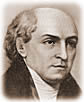
In a humble cottage in the little English village of Paulerspury, in the latter half of the eighteenth century, lived a weaver and his wife. To that lowly couple was born, August 17, 1761, a son who was to become famous as "the father and founder of modern missions." William Carey was his name.
When William was about six years old the family moved and his father became schoolmaster and parish clerk. He was upright and faithful in the performance of his duties, and was respected and esteemed by his neighbors. |
|
Young William attended his father's school and was a studious lad. At night he would go over his sums before he went to sleep. He was an ardent lover of nature and his room was filled with birds' eggs, insects, and botanical specimen. For reading matter he preferred books of science, history, stories of travel, and the like.
When the time came for him to earn his own living, he first attempted farming, and then turned to shoemaking, an occupation which, Coleridge said, has "given the world a larger number of eminent men than any other handicraft."
In a commentary belonging to his master he saw some Greek letters, and wondered what they meant. Determined to find out, he visited a poor man in his native town whom he knew to have been well educated, and from him received his first Greek lesson.
Young Carey was still unconverted. Lying was a common sin with him. At one time, having used some money belonging to his master, and intending to lie about it, his conscience so troubled him that he promised God that if He would "help him through" with this wrong act, he would abandon all sin thereafter. But the theft and the deception were found out and he was filled with shame.
Through the efforts of a fellow-apprentice, a Dissenter's son, Carey began to feel convicted of his sins. He then became very zealous, trying by works of righteousness to obtain God's favor. But at last he saw the fruitlessness of all this. He saw fully his sinful condition, and was converted.
He desired all the spiritual help obtainable, and listened to the preaching of able ministers whenever he could do so. A book — "Help to Zion's Travelers," fell into his hands and was read with great delight.
While still quite young he made an occasional attempt at preaching in a humble meetinghouse. His hearers were humble people and were well pleased with his efforts. He said afterward, "Being ignorant, they sometimes applauded, to my great injury."
He was united, when less than twenty years of age, to Dorothy Placket[t]; but the marriage was not congenial. She was predisposed to mental disease, and had little sympathy for the great work to which God had called her husband. But the nobility of his character was displayed in the tenderness he always manifested toward her.
Mr. Carey at this time was a stranger to temporal prosperity. He was carrying on a business in shoemaking, but the profits were small. Then sorrow came, in the death of his little daughter. He himself was stricken with a fever from the effects of which he did not fully recover for a long time, and they were almost at the point of starvation. A younger brother and a few friends came to their assistance, and they moved to another village where Mr. Carey continued his shoemaking, and also taught an evening school.
From this time on he preached more frequently and in 1791 he was formally set apart for the ministry. In the old church-book at Olney the following interesting item was recorded:
"August 10, Church Meeting. This evening our brother, William Carey, was called to the work of the ministry, and sent out by the Church to preach the Gospel wherever God, in His providence, might call him."
The first pastorate was at Moulton where he received about 10 pounds a year. He tried to supplement this meager salary by school-teaching, but being obliged to give up his school, he again tried shoemaking. Once every two weeks he walked to Northampton to deliver the boots he had made, and returned with a new stock of leather.
But his life was not to be spent in shoemaking. Thoughts of the heathen world and plans for its evangelization were already filling his mind. On the wall of his shop hung a large map he himself had drawn, showing each nation known at that time. On the map were written whatever facts he had read concerning these nations.
The first time Carey openly suggested the idea of foreign missionary work he was repulsed by a senior minister who said, "Young man, sit down. When God pleases to convert the heathen He will do it without your aid or mine." Others, however, encouraged him to continue his studies on the subject. The burden for the souls in heathen darkness never lifted from his heart, and in 1791 he urged the association of ministers to consider the question at once. Some interest was aroused, but no definite steps were taken.
The next year Carey was one of the preachers at the meeting of the association. From Isaiah 54:2,3 he drew two striking thoughts — "Expect great things from God; attempt great things for God." These words have lived through the years and have become a famous missionary motto. The fire of Carey's zeal kindled in other hearts and a missionary society was formed soon afterward. Carey published "An inquiry into obligations of Christians to use means for the conversion of the heathen in which the religious state of the different nations of the world, the success of former undertakings, and the practicability of further undertakings, are considered."
The next step to be taken by the little society was the decision as to the field in which laborers should commence, and the selection of the missionaries. Their attention was directed to a Mr. Thomas who had returned to England after spending several years in India as a surgeon. While there he had also put forth considerable effort to spread the Gospel. He was selected as one of the first missionaries to be sent by the new society.
After reading the account given by Mr. Thomas of conditions in India, Andrew Fuller, Secretary of the Society, remarked that there was a gold mine in India, but it seemed almost as deep as the center of the earth. "Who will venture to explore it?" he asked. Carey's reply came instantly — "I will venture to go down, but remember that you must hold the ropes." His offer was accepted and plans were made for him to accompany Mr. Thomas.
Carey's congregation was saddened at the thought of the departure of their beloved pastor, yet they dared not try to hinder his going where God called him. "We have been praying," one of the members said, "for the spread of Christ's kingdom among the heathen, and now God requires of us the first sacrifice to accomplish it."
"A great door and effectual is opened unto me, and there are many adversaries," wrote Paul the apostle. And William Carey might well have said the same. Immediately after their selection by the missionary society, Mr. Carey and Mr. Thomas began to make preparation to leave, but many were the difficulties they found in their way.
The greatest trial to Mr. Carey was his wife's persistent refusal to go with him. His entreaties were in vain, and the thought of a long separation was very hard to bear. His son Felix chose to accompany him, and together they left home. He wrote from Ryde, to Mrs. Carey:
"If I had all the world, I would freely give it all to have you and the dear children with me; but the sense of duty is so strong as to overpower all other considerations. I could not turn back without guilt on my soul. ...Tell my dear children I love them dearly and pray for them constantly. Be assured I love you most affectionately."
Another difficulty presented itself when the East India Company refused to give them permission to enter India. They decided to go without a license and boarded a boat, but a letter was sent to the captain, warning him not to take them, and they were compelled to go ashore. Every plan seemed thwarted, but they were undaunted, and very soon their courage and faith were rewarded. A Danish ship, they found, was soon to sail, and to their great delight they were able to engage passage at a very reasonable rate.
Mrs. Carey was again entreated to accompany her husband and this time consented, on condition that her sister might go with her. They sailed June 13, 1793.
The hardships already encountered had in no wise cooled Carey's ardor. Eager to preach as soon as possible, he spent his time during the voyage studying Bengali, and when nearing India he wrote:
"Africa is but a little way from England, Madagascar but a little farther. South America and all the numerous and large islands in the India and China seas, I hope, will not be passed over. A large field opens on every side. Oh, that many laborers may be thrust out into the vineyard of our Lord Jesus Christ, and that the Gentiles may come to the knowledge of the truth as it is in Him."
After a tiresome, stormy voyage they landed in Calcutta, November 9, and began at once to experience the hardships of life in a foreign land. Living in ease was no part of Carey's plan. "A missionary must be one of the companions and equals of the people to whom he is sent,"' he had written, and to this principle he adhered.
The trials were severe. It was hard to find a suitable place for the establishing of the mission, and in the meantime he wrote: "I am in a strange land alone, with no Christian friend, a large family, and nothing to supply their wants." Sickness came into the family. But he did not turn back. "All my friends are but one," he wrote; "I rejoice, however, that He is all sufficient, and can supply all my wants, temporal and spiritual ... Bless God, I feel peace within, and rejoice in having undertaken the work. I anxiously desire the time when I shall so far know the language, as to preach in earnest to these poor people."
In the marshy jungles near the Bay of Bengal was some land that could be secured free of rent, and in his extremity, Carey decided to locate there. An English gentleman offered him a bungalow where his family might live until he could build a house for them. But this place did not prove suitable for missionary work and God opened up something better. A Christian man, Mr. Udny, offered him a position as superintendent of an indigo factory at Mudnabatty. Mr. Thomas was offered a like position and they gratefully accepted the kind offers.
The experience obtained there proved invaluable in Carey's later work, and the salary he received supplied the needs of his family. But above all other advantages was this — it gave him abundant opportunity for the missionary work which he loved more than all else. In his factory were ninety native workmen to whom he gave Christian instruction, with Mr. Udny's full approval. Two hundred villages were within reach and from one to another he went, on Sunday, preaching in Bengali. His work gave him much leisure, which he spent in translating the Bible, realizing the importance of having God's Word in the language of the people. He also prepared a small grammar.
A wooden printing-press was presented to the mission by Mr. Udny, and when this was installed in one of the rooms at the factory, the wondering natives thought it must be the "idol of the Europeans."
In the midst of the work Mr. Carey was stricken with fever. After some time he recovered, but one dear little boy was taken from the family circle. The customs and superstitions of the people occasioned some difficulties concerning his burial. The father's mention of it is touching:
"When my dear little boy died I could not prevail upon any one to make a coffin, though we had carpenters in our own employ. With difficulty I engaged four Musselmans to dig a grave for him. No one would undertake it alone, and therefore many of them went together, that they might all have an equal share of shame. We went seven or eight miles for two persons to carry him to the grave, but in vain, and my wife and I had agreed to do it ourselves, when a lad who had lost caste and our 'mater' (a servant who performs the most menial offices) were induced to relieve us of this painful service."
At the end of five years the indigo factory had to be abandoned and soon the day came for the establishment of a permanent mission.
From the first, Carey believed that a missionary's life should be one of self-denial, and he never altered his views on this point. In a letter to Mr. Fuller in which he asked for more workers, he made this suggestion: "I recommend all living together in a number of little straw houses, forming a line or square, and having nothing of our own, but all general stock."
New missionaries arrived in 1799. They went at once to the Danish settlement, as the East India Company was hostile to missionary work. Colonel Bie, the governor, gave them a cordial welcome, inviting them to settle on Danish territory, and so Serampore became the home of the mission.
Among the new missionaries were Joshua Marshman and William Ward, whose names will always be associated with that of Carey.
Of the early church it is recorded — "All that believed were together, and had all things common," and the same description might be given of the mission at Serampore. Of the life of the missionaries we have a pleasant glimpse in this quotation from Mr. Ward's journal:
"About six o'clock we rise: Brother Carey to his garden; Brother Marshman to his school at seven; Brother Brunsdon, Felix, and I to the printing office. At eight the bell rings for family worship; we assemble, sing, read, and pray. Breakfast. Afterward, Brother Carey goes to the translation, or reading proofs; Brother Marshman, to school; and the rest, to the printing office. Our compositor having left us, we do without, we print two half-sheets of 2000 each week; have five pressmen, one folder, and one binder. At twelve o'clock we take a luncheon; then most of us shave and bathe, read and sleep before dinner, which we have at three. After dinner we deliver our thoughts on a text or question, this we find to be very profitable. Brother and Sister Marshman keep their schools till after two. In the afternoon, if business be done in the office, I read and try to talk Bengali with the Brahmans. We drink tea about seven, and have a little or no supper. We have Bengali preaching' once or twice in the week, and on Thursday evening we have an experience meeting. On Saturday evening we meet to compose differences and transact business, after prayer, which is always immediately after tea. Felix is very useful in the office; William goes to school, and part of the day learns to bind. We meet two hours before breakfast on the first Monday in the month, and each one prays for the salvation of the Bengal heathen. At night we unite our prayers for the universal spread of the Gospel."
From a set of resolutions formulated five years later, we make these brief extracts, which give us an idea of the spirit of these noble missionaries:
"We can never make sacrifices too great, when the eternal salvation of souls is the object, except, indeed, we sacrifice the commands of Christ."
"Prayer, secret, fervent, believing prayer, lies at the root of all personal godliness."
"Let us give ourselves up unreservedly to this glorious cause. Let us never think that our time, our gifts, our strength, our families, or even the clothes we wear, are our own. Let us sanctify them all to God and His cause... Let us forever shut out the idea of laying up a dowry for ourselves or our children. If we give up the resolution which was formed on the subject of private trade, when we first united at Serampore, the Mission is from that hour a lost cause... No private family ever enjoyed a greater portion of happiness, even in the most prosperous gale of worldly prosperity, than we have done since we proposed to have all things in common... If we are enabled to persevere in the same principles, we may hope that multitudes of converted souls will have reason to bless God to all eternity for sending His Gospel into this country."
Seven years Carey toiled on without witnessing a single native conversion, but the seed was taking root to spring up and bear fruit "in due season." One day Krishnu Pal, a carpenter, having dislocated his arm, came to Mr.Thomas for surgical help. He had heard something about the Gospel and realized his sinful condition. "I am a great sinner! a great sinner am I! save me, Sahib, save me!" His desire for salvation was genuine and he was converted.
December 28, 1800, Carey had the pleasure of baptizing his own son, Felix; then for the first time, the baptismal service was spoken in Bengali, as Krishnu Pal thus publicly professed his faith in Christ. Later in the day the Lord's Supper was celebrated in Bengali. The hearts of the missionaries rejoiced with joy unspeakable over this soul turned from darkness to light.
Krishnu Pal composed a hymn, the first stanza of which has been translated thus:
"Oh thou, my soul, forget no more
The Friend, who all thy misery bore:
Let every idol be forgot,
But, oh, my soul, forget Him not."
This first convert remained steadfast. Three years after his conversion, Mr. Carey wrote regarding a missionary journey, "Krishnu Pal accompanied me and rejoiced my heart."
Early in the nineteenth century Fort Williams College was established in Calcutta for the purpose of teaching English civilians the languages and customs of India. Carey's translation of the New Testament attracted attention to his proficiency in the vernaculars, and he was offered a position as teacher of Bengali in the new college. He accepted only on condition that the position should not interfere with his missionary duties. He was later chosen teacher of Sanskrit and Mahratta and kept the position until a few years before his death.
As the faithful missionaries continued their work, other natives were added to their Christian church; and opposition arose. But God definitely answered prayer and the enemy's plans were thwarted.
The first Christian marriage ceremony among the converts took place in 1803. The same year, an acre of land was purchased and set apart as a cemetery, and soon a convert who had been of low caste died. The body was placed in a plain coffin, covered with white muslin, and Mr. Marshman, Felix Carey, a Brahman convert, and a Mohammedan convert carried it to the cemetery. Thus another effort was made to loosen the bonds of caste.
In 1807 Mrs. Carey died, after having been violently insane for several years. In spite of her affliction, Carey's love and tenderness toward her never ceased.
Later he was united in marriage to Miss Charlotte Rumohr, a Danish lady, in whom he found a loving companion and the Mission a true helper.
A severe blow to all the missionaries was the Serampore fire, in which the printing office was entirely destroyed. Manuscripts and printed Bibles were burned, the type that had been made at the cost of so much labor was reduced to a mass of lead, and the work of years seemed lost. The financial loss also was great, but undaunted, they cleared away the ruins and began anew. When the news reached England, Christians at once rallied to the help of the missionaries, and in a short time funds sufficient to replace the loss were forwarded to Serampore. The type was recast, and a month after the fire, two editions of the New Testament went to press.
"Attempt great things for God, expect great things from God," was Carey's motto, and all through his long life he carried it out. Among the "great things" attempted and accomplished was the translation of the Scriptures, or portions of them, into the numerous vernaculars. Some of these translations Carey only supervised, while many of them he made himself. When he was correcting the last sheet of the eighth edition of the Bengali New Testament, he said, "'My work is done. I have nothing more to do but to wait the will of God." During his life the entire Scriptures were published in Bengali, Sanskrit, Hindi, Orissa, and Mahratta, and portions in thirty more dialects.
It was partly owing to Carey's efforts that the awful custom of sacrificing children in the "sacred'' rivers was done away with.
During the early years of Carey's life as a missionary he witnessed the burning of a widow on her husband's funeral pyre. He protested against the ceremony and warned those taking part in it that he would surely bear witness against it at God's judgment bar. And when, after many years, the proclamation abolishing this horrible practice of "suttee" was issued, he at once put aside his preparations for the Sunday services and set about the translating and printing of it. The proclamation was ready for distribution Sunday evening.
Through all the forty-one uninterrupted years of Carey's missionary career, his zeal was unabated. But at last his strength failed — the end was drawing near.
On one occasion, when Alexander Duff visited him, the conversation was about Carey's work, until he whispered, "Pray." Mr. Duff prayed and then started to leave the room. But Carey's feeble voice called him back. "Mr. Duff," he said, "you have been speaking about Dr. Carey, Dr. Carey; when I am gone, say nothing about Dr. Carey — speak about Dr. Carey's Savior."
One of his fellow-missionaries wrote of him, "He is ripe for glory and already dead to all that belongs to life."
On the morning of June 9, 1834, his earthly life ended. The next morning a long procession of sincere mourners wended their way to the cemetery. A heavy rain seemed to intensify the sadness of the occasion. But as the procession stopped at the grave, the rain ceased and the sun shone out in all its glory, bringing thoughts of that glad day when the dead in Christ shall rise, and sorrow and death shall be forever banished.
The last resting-place of the venerable missionary was marked only by a simple epitaph of his own composing:
Wm. Carey
Born, August 17, 1761
Died, June 9, 1834
"A wretched, poor, and helpless worm,
On Thy kind arms I fall."
Forty-one years in India! Reader, the field still needs workers. And the promise is — "He that reapeth receiveth wages, and gathereth fruit unto life eternal." |
| |
| John Wycliffe |
In the year 1324, or about that time, according to the conjectures of all his biographers, Wycliffe was born, in the parish bearing the same name, in Yorkshire, England. His name
been spelled in nearly twenty different ways; but we have followed the custom of the Editors of his Bible, published first by the University Press at Oxford, 1850. Nothing is known of his childhood or early youth. In the year 1340, at the age of sixteen years, he was admitted as a student at Queen's College, Oxford, which was then first founded. He was soon transferred from this to Merton College of the same University, which from having been longer established, possessed superior advantages, and at that time could boast of having connected with it some of the most learned men of the age. The college students at that period devoted most of their time to the study of scholastic theology and civil law. Wycliffe took high rank as a scholar. Even the Roman Catholic historians confess that he was a subtle disputant, and second to none in philosophy. He did not, however, confine himself to the prescribed studies. He carefully read the writings of the fathers, and although the Sacred Scriptures were then almost entirely neglected by the ecclesiastic, Wycliffe devoted much time to their study. About the year 1360 he appears as a bold and successful assertor of the rights of the University against Mendicant Friars, who had become so numerous and powerful at Oxford as almost to threaten the entire ruin of the University. |
|
 |
|
Their endeavor was to lead young men who had entered Oxford to be educated, to leave the University for the Monastery, and so powerful was their influence that, it is said, the number of students was reduced from thirty thousand to six thousand. In testimony of their gratitude for his services, and in compliment to his talents, the university made him, in 1361, blaster of Baliol College, and presented him to the living of Fillingham, which he afterwards exchanged for that of Ludgershall. Four years after, in 1365, he was appointed Warden of Canterbury Hall in Oxford, by Archbishop Islip, its founder. The diploma conferring this honor declares Wycliffe to be "a person in whom his Grace very much confided, and on whom he had fixed his eyes for that place on account of the honesty of his life, his laudable conversation and knowledge of letters." Islip died the next year, and Bishop Langham was raised to the See of Canterbury. He was a monk and was strongly attached to the religious orders which Wycliffe had so boldly censured. His dislike to the Reformer was so great, that he deprived him of the office which the founder of the college had conferred on him. An appeal was made at the Court of Rome; but after delay of four years, the Pope confirmed the action of the Archbishop.
In 1372 Wycliffe was appointed, by the Chancellor and Regents of the University Professor of Divinity. This was the greatest honor which they could offer him, and it shows conclusively the high estimation in which he was then held. He was soon called upon to take part in the controversy which was being waged between the Court of Rome and the English Sovereign. The Pope had demanded annual payment of 1,000 marks, as tribute money, and as an acknowledgement that the sovereignty of England was under the authority of the successor of St. Peter. Edward the Third had for several years declined to make these payments, and it was now threatened that his Majesty would be cited to appear for trial before the Sovereign Pontiff Edward appealed to Parliament, who resolved to resist the charge by force, if necessary, and Wycliffe maintained and defended the rights of the King against the Pope. In 1374 Wyclifle was sent to the Continent upon an embassy to the Pope, to treat concerning the liberties of the Church in England. He remained abroad two years, carefully studying the policy of the Pontiff, and returned to England more thoroughly convinced of the gross corruption of the Romish Church; while his zeal in exposing her errors and vices was considerably increased, and his opportunities for spreading his views were very great. Wycliffe's doctrines gave so much offence to the clergy of the Romish Church, that in 1377 he was summoned to appear before a convocation which met in St. Paul's Cathedral in London, to answer for his heresies; but the assembly broke up in confusion without taking measures against him. But later in the same year the Pope commanded that he should be arrested, and kept in security till further orders. The University was enraged, and debated whether to receive the Pope's messenger or dismiss him disgracefully. But Wycliffe concluded to meet his accusers face to face, at a Synod appointed for the purpose at Lambeth, in January, 1373. Whether they would have silenced the Reformer or not, is uncertain, for during their deliberations a mandate from the queen mother forbade their proceeding against him, and he was dismissed with the simple command to abstain from preaching his doctrines in future. About this time he was engaged in translating the Bible. His writings abound with sound Protestant views on the supreme authority of the Scriptures as a guide to faith and practice; but his enemies took advantage of some disturbance which they unjustly charged to his teaching, and he was banished from the University in 1353, retiring to his living at Lutterworth where he died in 1384. The translation of the Bible was the chief and crowning glory of his life, and the lever by which the Papal power in Great Britain was overthrown. We are confident that an impartial examination of his claims will confirm his right to be called the most important agent in producing the Protestant Reformation. More than a century before Luther was born, Wycliffe had planted the seeds of the Reformation, and with great boldness and perseverence had promulgated those principles which were to shake the Romish Church to its centre. He was the "Morning Star of the Reformation," the pioneer and patriarch of Protestantism, and his name should have the highest place on the roll of its honored heroes. |
| |
| William Tyndale |
 |
|
To no mere man does the world owe more, than to William Tyndale, the chief of the English Reformers. He was born (probably) in 1485, the year in which Henry VII. came to the throne; there is some doubt with regard to the exact time. The Romish Church was never to appearance more firmly established in England than at this period. The King made close alliance with the Pope, and all classes seemed content in submitting to his authority. But the foundations of the Church were, nevertheless, insecure; the period of its worst oppressions and abuses was running out, and the man who was to do more than all others to overthrow its influence in England was already born. The materials for the narration of Tyndale's early life are scanty. The first notice we have is of his being sent to Oxford, where, says Foxe, "he increased as well in the knowledge of tongues and other liberal arts, as especially in the knowledge of the Scriptures, whereunto his mind was singularly addicted." In 1517 or 1518, he left Oxford for Cambridge, where he remained as a student for a year or two, leaving in 1520 for Gloucestershire, his native county, than which there was no part of England more under Papal dominion; nowhere were the abuses of the Church more flagrant, or the ignorance of its ministers more extreme. Tyndale's bold rebukings of these things made him extremely unpopular, and being secretly charged with holding heretical opinions, he was summoned before his bishop, who reproved him severely; whereupon he left the county for London, hoping to be able to execute a desire, which had long been in his heart, of translating the New Testament. |
|
Wycliffe's, the early English translation in existance, had become obsolete. The Bible was a sealed book to the people; and the clergy, consulting their own interest; strove to keep it so. They perverted its teachings to their own support, they wrested its meaning to their own purposes, and they darkened its truth with the mist of their own sophistry. But Tyndale found, to use his own words— "not only was there no room in my Lord of London's palace to translate the New Testament, but also that there was no place to do it in all England." So, in January, 1524, a voluntary exile, alone and unsupported, he left London for Hamburg, where; for more than a year, he labored on his translation. In May, 1525, he went to Cologne, in order to print his translation there- But Cochlaeus, the noted controversialist, who happened to be in Cologne at this time discovered that the printing was going on, and determined to stop it. He prevailed upon the city authorities to interdict the printer from proceeding, while he wrote to Henry, to Wolsey, and to Fisher, Bishop of Rochester, to warn them against the translation, that they might keep this "most pernicious article of merchandise" from entering the ports of England. So Tyndale leaves for Worms, then a Lutheran city, where the printing is finished—one edition containing the commentary of the translator, the other the simple text. By the spring or summer of 1526, copies of these editions must have been in England, where prohibition was violently made against them by the ecclesiastical authorities, and all persons were warned, under pain of excommunication to deliver up "all such books as contained the translation of the New Testament." But the attempts to suppress them were not entirely successful, and the number of readers increased, both in England and abroad, though the authorities burned all the books they could obtain.

Meanwhile Tyndale still remained at Worms, writing tracts and treatises against religious abuses in the Catholic Church, and in favor of the Reformation, and these also were circulated in England. In 1539 the Bishop of London summoned a convocation of the clergy, and its session ended with the issuing of "a proclamation against the importing, printing, reading, or teaching of specified books," in the English tongue, as well as in Latin and other languages, replete with the most venomous heresies, blasphemies and slanders, intolerable to the ears of any good Christian man, and reviewing the penalties of previous enactments against heresy. In noble pre-eminence among the books proscribed were all the publications of Tyndale. But the proclamation had little effect to prevent importation and study of these books; and early in 1530, Tyndale published a translation of the five books of Moses, and "a work of his own with the ominous title, The Practice of Prelates." It was intended as an exposition of the means by which the Church had acquired temporal power, and of the grasping spirit of the prelacy. As may be imagined, the enemies of Tyndale desired to have him in England, and in their power; and at the command of Henry VIII and Cromwell, overtures were made to induce him to return. But his prudence would not let him. Meanwhile, many persons who had read his books, and adopted his opinions, were burned in England, and still a great demand existed for his translation of the New Testament. In 1535 he was actively engaged at Antwerp in revising the translation and issuing new editions of it. His residence being ascertained, persons were sent over to accomplish his arrest. By an act of treachery he was decoyed to Brussels, and conveyed to the Castle of Filford, or Villefort, where he was closely confined. As soon as the English merchants had learned of this outrage, they applied officially to the Court of Brussels for the release of Tyndale, and afterwards letters were sent out from England by Cromwell, with regard to his release. But they were all of no avail, and the last hope of aid had now expired. After he had remained in prison for more than a year, an advocate, was offered to him, but he refused to have one, saying that he could make answer for himself. No account of his trial remains; but after much reasoning when no reason would serve, he was condemned to death. There was no timid doubt, no faithless fear in him. On the 6th of October, 15:,6, he was led forth to die. He was bound to the stake, and his last words were, "Lord, open the King of England's eyes ?" He was strangled, and his body was then burned.
To a man like Tyndale, death could have come only as a blessing from God. The sorrows, the trials, the toils of life were over. The reward had come. A life like his deserves special remembrance in these days. The times in which we live are so happy, so free from religious persecution, that we are likely to forget our blessings from their very commonness. There is but little opportunity for the exercise of the self-devotion and faith of the Reformation, we are likely to have the worthless substitute instead of the priceless original. There can be no better remedy for this than to honor the true virtues in the lives of the martyrs of the past. We give on the preceding page a facsimile of Tyndale's first New Testament, which will be interesting to our readers, from the antique beauty of its typography.
|
| |
|
|
|
|
|
|
|
| |
|
|
| |
|